I will see many come and go as I spend my life in prison. I’ll see many of them get out, only to hurt someone else and come back. Not just once or twice. Several times, behind a crime that usually ends up being drug or gang related. The sex offenders like to use the excuse; oh it was the drugs. We all know that’s a load of horse shit.
So in NA tonight I spoke about feeling hysterical sometimes when I get real manic. I realized that I get hysterical about small problems. And I turn them into big unnecessary problems. I really didn’t like realizing that about myself. But I will tell you this. I love my NA. Just sitting there sometimes I here a person speak and I get insights into my own thoughts and feelings. It is interesting how alike we all are. Yet most of us intensely insist, (We are not like those guys!) When we are the same in so many ways. Meth addicts often become sexualy addicted. Or addicted to sugar. Some of us heroin addicts tend to have to take a crap Right before we fix, or on our way to score dope.
So where am I going, well as an addict I have victimized more people than I realized. Selling heroin to people, victimizes them and their families, friends, and others in their lives. Not to mention the victims they will create when they get desperate for their fix. Because as we all know, addicts will do any thing to get their dope. And yes sexual deviance is a huge part of a great deal of addicts lives. Whether they will admit it or not. I’m not saying addiction makes sexual deviance excusable. Quite the opposite. Drugs often bring a persons true colors to light.-Brent Brents 8-25-16
Tag Archives: victim
The sex offenders like to use the excuse, oh it was the drugs.
Filed under Brents' writings
Have You Ever Met a Monster, Part IV: Our society cares more if a sexual assault victim is the right kind of victim
 Brents has often said that by the time he was 9, his brain was broken.
What if someone had intervened in his life early on? A teacher? A neighbor? How could no one have noticed that boy who went to school with bruises, smelling like urine because he had wet the bed the night before rather than creep down the hall to the bathroom and risk waking his father?
If you help an abused child, you might be preventing a lifetime of pain—for more than one person.
So many people live in what I call “garage houses”—where the garage is the dominant feature. They pull up to their garage at night, the door goes up, their car goes in, and the door comes down. They stay inside their house until they leave the next day. They can’t tell you the name of the family down the street. They won’t interact and they sure won’t intervene.
What if we dared to care—without hesitation, without condition?
It’s a harsh truth that our society cares more if a sexual assault victim is the right kind of victim. Remember how police told Margaret the DNA from her case would sit on a shelf for at least two months? When Brents attacked victims in a high-income neighborhood, the DNA was processed within hours.
Lady Justice might be blind, but she can sure have a champagne taste.
Margaret and I talked often while her case wound its way through the court system. During a hearing in July 2005, Brents pleaded guilty to Margaret’s attack.
Like many survivors who struggle with Post Traumatic Stress Disorder, Margaret was terrified of leaving her house. She had flashbacks, nightmares. She couldn’t hold down a job. Her marriage fell apart.
On the day before the hearing, Margaret asked me to deliver a message to Brents for her, and I agreed. And this was her message:
“Tell him…I forgive him.”
It’s stunning, isn’t it? How could she forgive this man who wounded her so, who nearly took everything from her?
She said, “I’m not feeling bad for the man who tried to kill me, but for the little boy who had the same thing happen to him.”
And she said, “Hating is not hard. But if I go on hating him, I will never get over it.”
Then she added, “If it was me, I would want people to try to help me or try to listen to me and not just look at me like I’m an animal or a monster.
She inspires me. If Margaret can forgive Brent Brents, we can forgive anybody.
This case had a profound effect on my life.
It taught me that we’re all connected, and turning our backs on others is really abandoning ourselves.
It made me realize that I didn’t like the journalist I had become. It was actually Brents who pointed out to me that he and I had something in common: We were both driven.
I quit that job shortly after his case ended. I will never again work in a newsroom because the desperate competition for ratings is unhealthy for me, in many ways.
And I no longer knock on a survivor’s door unless I’m invited.
I began interviewing Brents because as a journalist who has spent a lifetime reporting on sexual violence, I wanted an answer to the question, “Why?”
He began as a bug under a microscope–and that’s what I told him.
He became a lesson in humanity and compassion.
Even so-called “monsters” have things they’re afraid of.
Brents wrote me about his. He said,
“My biggest fear is that I will die (pause) without ever having done anything good.”
That’s why I tell this story. Thank you for listening.

BRENT J. BRENTS — At age 13
Filed under The story
Have You Ever Met a Monster, Part III: What are we doing wrong as a culture that we continue to produce rapists?
It turned out that Brents had followed my work. A few months before he was released from prison I had finished co-authoring an investigation into how the military mishandles domestic violence and sexual assault. It resonated with him, not because he was a perpetrator, but because the angry man-child within him, considered himself a victim.
Records and accounts from family members indicate that Brents’ father was a violent, sadistic man. The two children from his second marriage were removed from the home because of his abuse, and Brents and his brother, the product of his father’s third marriage, were also removed from the home, although for unknown reasons, Brent was returned.
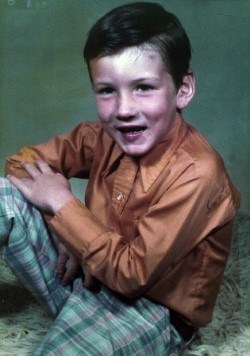
This is Brent’s first grade picture. His father had been raping him for three years by then. A few weeks after this next picture was taken,
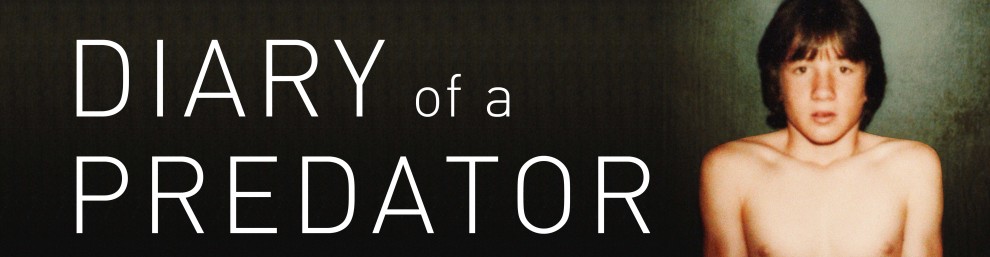
BRENT J. BRENTS — At age 13
when Brent was 12, his father beat him so badly that Brent suffered what medical records described as a left orbital blowout fracture—his left eye socket was broken. He’s had seizures ever since. I will spare you the details of the sexual torture he endured. He said his father told him that he himself had been beaten and sexually abused as a child by his father, Brent’s grandfather.
And so the pattern repeated. Pain, degradation, shame. Brent Brents did to others what had been done to him as a boy, and while he was still a boy, like many victims, he blamed himself. He once wrote, “I can’t remember much about when I was real young except fear and shame and lack of courage.”
Shame is an enormous trigger of violence. Brents told me that after that detective said to him, Turn yourself in you little punk, he, Brents, worked himself into a rage. Then he went on his final horrifying crime spree.
I’m not saying these factors are an excuse for the violence Brents inflicted upon others. He made choices. He absolutely deserves to spend the rest of his life in prison. But knowing what happened to him helps explain why someone like Brents committed such violence with a lack of empathy–that his brain was predisposed toward it, and the abuse inflicted on him was his model.
It’s human nature to want to distance yourself from someone like him. Label him as a “monster,” dismiss him as evil, because we don’t want to have anything in common with such a monster–it could mean we, too, are capable of monstrous things.
It also makes it too easy. When we put rapists in the category of “monster” it may make us feel safer today but it’s more dangerous for tomorrow. Because then we won’t believe that the “monster” can be a neighbor, a good friend, a coworker. That enables them to hide in plain sight.
The dominant theme of how to prevent sexual assault today is cloaked in helpful advice, like don’t walk alone, don’t drink, don’t put yourself at risk—and the message, primarily to women, is, Don’t. Get. Raped.
How about we turn the spotlight to a different population and say, Don’t. Rape. And then take it one step further and ask, what are we doing wrong as a culture that we continue to produce rapists? Because whether it’s the ex-convict who attacks a stranger, the college boy who rapes his girlfriend or the celebrity who drugs and assaults his victims—they’re all choosing to exert their anger, power and control over someone else. With that choice, they are all the same, and they all leave pain in their wake.
I’ve interviewed more than fifty survivors of campus sexual assault in the past two years alone and the details I learn about their perpetrators paint a picture of SO MANY young men being deliberately predatory. They isolate their intended victim, ply them with alcohol or drugs, lock doors, ignore tears, ignore pleas to stop or ignore the fact their victim is limp with fear or is unconscious.
Ten years ago, Brent Brents was sentenced to 1,509 years. Today all over this country we are seeing new generations of serial rapists. Why is this still happening?
Why do we continue to reinforce the message to boys and young men that their worth is linked to their ability to dominate?
What if we prized compassion more than power?
When they’re little, we tell our children to play nicely in the sandbox.
As they get older, we say, don’t get in fights on the playground. Take a breath, count to ten, walk away.
Then they get even older and we teach them about the biological aspects of sex—health and reproduction.
What if we evolved those conversations with our youth, and teach them how feeling shame, feeling powerless or feeling angry–all of which cover up hurt and rejection—COULD cause them to want to dominate someone else?
And that they can learn to recognize triggers and not act upon them.
At least start that conversation.
And then speak up if you witness predatory behavior—and you’ll know it when you see it. Don’t make excuses. Don’t look away. Don’t cover it up.
And because sexual violence happens on a continuum—escalating from verbal harassment to physical attacks–Speak up when you hear or read a joke about sexual assault, or victimization. It’s not funny, it’s not sexy. It’s dangerous.
If someone confides in you they’ve been assaulted, believe them–false reporting is extremely rare, so yes, believe them. Listen to them without judgment. Help them find resources, and then support whatever they decide to do.
For perpetrators– Brents told me that group counseling for sexual offenders in prison does not work. For an inmate to even be seen going to sex offender group risks their safety, and once there, they don’t want to be seen as vulnerable. It’s hard to change when you’re living in fear. And if we really do want to help them try to change, let’s offer more of the respect and compassion that can be felt with one-on-one, focused attention—something a damaged person desperately needs.
Instead of building more prisons and focusing only on punishing the perpetrators, why don’t we try to prevent them?
Filed under The story
Rape was a murdering of the soul
So I’ve heard this lately (It was consentual.) Holy crap it enfuriates me. How do 5 year olds consent with a man shoving a penis in their asses repeatedly. Or an unconcious woman consent. These guys use this to make it ok, or make themselves less responsible. I know I’m No better than these guys who tell me this. I tried the same crap for a minute. Yet i came to the reality that they (the victims) did not consent. By saying it was consentual, I placed the responsibility on the victims. I just can’t see why i needed to do this. It didn’t make me feel any better. I still knew i was predatory. I still knew Rape was a murdering of the soul.
Don’t get me wrong that same person Resides within me. But i know i have to constantly be aware of how i am thinking. When i get angry or anxious i become that person again. I don’t rage as often as i used to. I credit my pysch meds for that. But still i rage inside sometimes.
-Brent Brents 2-20-15
Filed under Brents' writings
the cost of testing those rape kits. No one holds 5K walks or car washes
Note from Amy:
This excerpt is from a letter sent by Brent Brents in August, shortly after news stories began focusing on the tens of thousands of untested rape kits that exist at police departments around the country.
OK get to the point Right. So lets take the most obvious killer in the world. Cancer. When someone gets cancer these days, they can often have a team of people assembled to help them.
The same could be said for the victim of sexual assault. But we come to the cost of testing those rape kits. No one holds 5K walks or car washes, or charity auctions to raise money for the testing of these kits past and present. Theres no Dave Thomas to leave a portion of his estate to victims of sexual assault.
So I’m asking people to step to the plate. First off go to your local city, county or state authorities and find out how many Rape test kits are stored untested. Find out the cost to test the kits. Hold 5K survivors walks, sexual assault survivors charity auctions, bake sales, car washes. Seek Donations….and whatever these Events generate in money give it to your city, county, and state authorities. Make it specificaly for the testing of those kits.
Sexual assault always carries a stigma of shame and there are neandrathal thinking people. This is 2015 the world is not stuck in endless cycle of ignorance. Rape is not a victims fault in any way. But the world is still only paying lip service.
Kill a Lion, a whale, fight Dogs and there are millions who fight their battle. Someone gets assaulted and there is only the judicial system, which, let’s be realistic is only going thru the motions. The police and prosecutors No matter how caring and sincere, are Limited by barbareck and outdated laws, Limited funds, and authorities who often are burned out.
Please People….please run with it.
-Brent Brents 8-18-15
Filed under Brents' writings
my Racial and bigoted self
So Amy back to last Nights thoughts. Right my Racial and bigoted self. Rarely do i react with extreme prejudice. I often like i try to handle situations with men or women of different Races, In a decent way. But the truth is i am just like most people of any Race. We’ve certain misconceptions. Blacks like fried chicken, Asians like Rice and Raw fish, white people hate every one, etc. The truth is we are all situationaly Racial. No matter our Race. In prison Racial segregation Is a must for every ones survival. Every one has to choose Right from the start whether or not they are going to be victims or Victimizers in prison. Sheep or wolves. Young white boys hangin with the blacks or hispanics automaticly gets a Lable of some kind. It’s just the law If your not with your own, your weak or No good.
Me i have always chosen to be the wolf. But when i cam back to prison my case automaticly put me in the Sheeps pen. Am i a true hate monger, No. I think Hitler was a psycho with to many people just like him. Do i trust blacks, hispanics, or asian, or any other race? Hell No. This is prison. 99 % of the people you enteract with want something from you.
–Brent Brents 5-1-15
Filed under Brents' writings
Jameis apologize. Your victim deserves that
Note from Amy: While I was the investigative producer on the documentary “The Hunting Ground,” which features the Jameis Winston case, I had nothing to do with Brent Brents making the below statement, which he sent on March 31–before Erica Kinsman’s attorneys filed suit against Jameis Winston on her behalf. What is posted below is entirely the opinion of Brent Brents. As with all his writing, I did not censor or copy edit it:
Some of you will see Jameis Winston get drafted into the NFL soon. Most likely #1 overall for 100 million dollars Plus. With 50 to 55 million Garunteed.
This article (he enclosed a clipping of this column by Christine Brennan, USA Today) is a step in the right direction. But far short of the punishment he truly deserves. I can say with a whole heart, that you Jameis Winston are a Rapist. You got lucky that campus police and city police Royaly screwed the pooch on the investigation and victims allegations.
Your vulgarity at the campus directed towards the survivor of your criminal behavior, your track record of dumassed behaviors, don’t lend any credit to your reputation of Mr. Innocent.
I’ve watched your Interviews, and read plenty to judge you. God says we shouldn’t judge others. But hey let’s be real. And you and most any right thinking human beings know in your hearts the truth. Guilty!!! I have a closer Knowledge so i know more than most. But There are things that make 1 plus 1= 2.
99.99 % of sexual assault victims tell the truth in my opinion. I could be wrong. But i don’t buy that you are that .1 % of that not guilty.
So Winston as you embark on the next phase of your young life. Remember that many young people are going to Look up to you and follow your lead. Your going to be a role model for young people everywhere. Your an exceptional football player. So become an exceptional man. It may seem truly hypocritical, but i feel you should become the biggest advocate for anti Rape and domestic violence causes.
When you lose the lawsuit that is surely coming, pay it. Don’t be a punk ass Kid. And Jameis apologize. Your victim deserves that if nothing else. How you do that will be up to you. You’ll have a team of lawyers, an agent even a teams front office all saying don’t do it. Kid if you have a good heart do the right.
Who am i you ask, to judge you and write this letter? I am a serial rapist who’s 33 years in lockup have kept him around Rapists of all kinds. So I know you. Get your shit together Kid.
B. Brents 3-31-15
Filed under Brents' writings
A Lesson from Reporting on Rape
In case you missed it: Rolling Stone magazine published a story about campus sexual assault that featured a victim named Jackie whose account turned out to largely untrue, prompting the Columbia Journalism Review to issue their report that analyzed how and why seasoned journalists could be led astray.
Reporting on rape and sexual assault is extremely tough. There are few other crimes where the victim is left so deeply traumatized, and a journalist trying to interview a rape victim has to gingerly navigate the minefield of that raw, emotional injury while also getting the details of what they need for their story. In an effort to not cause them more harm, you may not press hard enough for the facts. Or you may inadvertently veer in the opposite direction; not read them correctly and press too hard. It’s an enormous challenge to remain dispassionate in the face of someone’s palpable pain, and I’ve come to believe that empathy accomplishes much more because it motivates you to try to illuminate the injustice and tragedy of this crime. Finally, a reporter’s own personal experiences can sometimes cloud their judgment if they become triggered themselves.
Any journalist who frequently tackles trauma reporting and tries to do so in a responsible way will at some time or another fail in their endeavor. It’s called being human. The failure might not be of the magnitude or in the public’s eye like the one in Rolling Stone–it may be known only to you and the subject–and might be of a different sort, but a failure nonetheless. The thing is to learn from it.
I had one such lesson burned into my memory (and rightly so) by a female military veteran whose case I was covering for the series Betrayal in the Ranks, an investigation into military sexual assault and domestic violence I co-authored with Miles Moffeit at the Denver Post.
Miles and I were in the midst of writing, and I needed a document from the victim in question. On deadline and in full efficiency mode, I left a brisk message on the answering machine of her home phone with the details of my request. The response I got hours later was blistering, and I will do my best to paraphrase it here:
“So I just got home, and it was a good day and I was in a great mood, and then I hit the button on my answering machine and out of the blue there’s your goddamn message asking for that fucking piece of paper for the story. And now standing here in my hallway you’ve yanked me back to that memory, and there’s nothing I can do to get rid of it now.”
I’ve never left a specific message for a victim since. If I need information, I will call or email and simply ask in a general way for them to call me when they can. If it’s urgent, I will indicate that it is, but I won’t dive into details of what I need on the message. I save that for an actual conversation, where I then do what I used to describe to my students as “wading in and out”: You wade into the murky water of their pain, slowly, holding their hand as you go. You then extract the detail you need, and together you carefully wade back out.
I was reminded of this the other day when I was tagged on a thoughtful post by Bruce Shapiro, the executive director of the Dart Center for Journalism & Trauma, about the challeges of reporting on rape. I’ve copied his full message below:
What is most important about the Rolling Stone controversy: It’s an outlier. Investigative reporting on institutional complicity in the coverup of sexual assault is one of the major innovations in American journalism in the last 15 years.
Think about reporting on clerical sex abuse by Walter Robinson, Sacha Pfiefer, Kevin Cullen and others on the Boston Globe’s Spotlight team; the pioneering investigations of sexual assault on college campuses by Kristen Lombardi and colleagues at the Center for Public Integrity; the Denver Post’s revelations of rape in the U.S. military by Miles Moffeit, Amy Herdy and others; Rachel Dissell’s recent work in the Cleveland Plain Dealer’s recent exposes on untested rape kits.
Each of these far-reaching investigations involved very sensitive reporting on victims; careful corroboration and confirmation of highly emotional stories; and meticulous documentation of various institutions’ role in coverup. In all of these investigations, reporters had to negotiate very carefully with deeply traumatized rape survivors, and develop a thorough method and ethic for reporting on their claims.
These reporters all understood both the unique challenges in interviewing survivors of private, deeply stigmatized rapes; and the very high stakes, for all involved, in getting the story right.
Filed under Uncategorized
Reader: I once was a victim of rape. I’m no longer a victim
Note from Amy: The following message is testament that the book Diary of a Predator: A Memoir has a profound effect on survivors:
Hi Amy,
I am moved by your work. No, not by your work as a writer – but the amount of inner work you’ve done to expand your compassion to include the suffering human beings within all the victims of rape, perpetrator included.
I once was a victim of rape. I’m no longer a victim because I was able to find compassion for my perpetrator. I believe it literally dissolved the toxic cells within my body to allow a new space, or perhaps, a renewed space to exist.
It’s interesting to me that so much is put upon the entity “forgiveness”. It always felt somehow abstract, like a word created by man, but allusive to behold in my body. Compassion though has true relevance, true power.
I could go on and on. I’ll just stop here by saying, thank you for your work that you put into this world: this truly panoramic embracing of humanity. I feel bigger and brighter and wider by the experience. You are giving all of us this opportunity.
Diedrich
Filed under Uncategorized


 Diary of a Predator
Survivor: “I have been trying to find the courage to speak about having compassion for perpetrators of violence”
Comment: Hi Amy Herdy,
Your Ted talk led me to this website. As a survivor of childhood sexual abuse, I want to thank you so much everything that you have brought to light in the talk and in writing, as I feel that it is something that needs to be said. I have been trying to find the courage to speak about having compassion for perpetrators of violence like this, because while it is hard to learn to forgive, there is a fact that I truly believe in: every person who does harm has been harmed.
I strongly believe this because of the stories I was told throughout my childhood by people who abused me. Almost every single one of them had a story about being abused as children, and they would often tell it to justify why they were hurting us. As a child, I was “trained” in very specific ways in how to abuse other children and in how to recruit children to bring back to sick adults to be abused. I have watched cousins and childhood friends turn to addiction and take on masks of mental illness to try to disguise what happened to us as children.
The reason that I feel compassion in spite of the anger about my life, is that, had it not been for a couple of extremely loving adults in my childhood who balanced out the pain, I cannot say that I would have turned out any differently than those who abused me. I experienced abuse as a sickness that is passed from generation to generation or from person to person. The difference with sexual abuse is that, unlike having a leg cut off and bleeding all over the place for the world to see, it is something that is so stigmatized and set in the category of “sexual.”
Knowledge of healthy sexual relationships isn’t something that children are typically exposed to as it is. But this is not a “sexual” thing. It is a “power” thing. In my experience, sexual abuse has more to do with one person feeling so powerless in themselves that the only way that they feel like they can have any sense of power in life is through taking advantage of others who are more vulnerable to them. This is the sickness.
In our society, we treat the symptoms of this sickness by throwing perpetrators and victims in jail, instead of trying the much simpler path of prevention. It makes way more sense to help children than to try to patch together broken adults. Thanks again for your work.
-Hannah
Time: June 29, 2017 at 6:42 pm
1 Comment
Filed under reader comments
Tagged as abuse, addiction, Childhood sexual abuse, healthy sexual relationship, mental illness, perpetrator, perpetrator of violence, perpetrators of violence, sexual, sexual abuse, survivor, survivor of childhood sexual abuse, victim, victims