I will see many come and go as I spend my life in prison. I’ll see many of them get out, only to hurt someone else and come back. Not just once or twice. Several times, behind a crime that usually ends up being drug or gang related. The sex offenders like to use the excuse; oh it was the drugs. We all know that’s a load of horse shit.
So in NA tonight I spoke about feeling hysterical sometimes when I get real manic. I realized that I get hysterical about small problems. And I turn them into big unnecessary problems. I really didn’t like realizing that about myself. But I will tell you this. I love my NA. Just sitting there sometimes I here a person speak and I get insights into my own thoughts and feelings. It is interesting how alike we all are. Yet most of us intensely insist, (We are not like those guys!) When we are the same in so many ways. Meth addicts often become sexualy addicted. Or addicted to sugar. Some of us heroin addicts tend to have to take a crap Right before we fix, or on our way to score dope.
So where am I going, well as an addict I have victimized more people than I realized. Selling heroin to people, victimizes them and their families, friends, and others in their lives. Not to mention the victims they will create when they get desperate for their fix. Because as we all know, addicts will do any thing to get their dope. And yes sexual deviance is a huge part of a great deal of addicts lives. Whether they will admit it or not. I’m not saying addiction makes sexual deviance excusable. Quite the opposite. Drugs often bring a persons true colors to light.-Brent Brents 8-25-16
Tag Archives: Brent Brents
The sex offenders like to use the excuse, oh it was the drugs.
Filed under Brents' writings
It is creepy some times to hear the depths of violence and hatred that is spoken
I was sitting in the yard the other day. Just watching every one and every thing. Listening to words and conversations as people passed by. Its is creepy some times to hear the depth of violence and hatred that is spoken and communicated. As I sat there I thought of the countless victims we are all responsible for. Known and unknown. All the hurt we’ve caused so many thousands of people here alone. Not to mention the hidden damage we’ve caused our families friends and other innocent people. Its a brutal reality when you get right down to the plain truth of it all. Then one has to think about the lasting effects of their hate and violence.
The children’s lives, we’ve violated them in so many ways. Sexualy, physically, Mentally. And it is a life time of violation. Sure we may only do it once. Rape one child or adult, murder someones family member, rob some person or place. These things leave a wake of damage. Often there is no one to help repair the emotional trauma.
-Brent Brents 8-25-16
Filed under Brents' writings
What would Brent Brents tell his younger self? “That the empathy he has, and is about to abandon is crucial to becoming a man”
So what would I tell the younger me. Honestly that would depend on what age were talking about. I suppose it really wouldn’t be that complicated. I was a pretty savy individual at the age of ten.
So first thing would be run, and run far. And stay away. I have put a lot of thought into the years between ten and thirteen. Being beaten wasn’t nearly as damaging to me as the rape. The rape taught me how to be deviant. And it was about this time I learned it could cause much more than just physical pain. I began to get an understanding of emotional abuse.
So I think I would like this kid to know that the secret world of abuse was not shameful or ok. I would tell him that the empathy he has, and is about to abandon is crucial to becoming a man. I would tell him that he should tell every one he could about the abuse at home. Every time, and not give up in that pursuit at getting his life back…
Even though I was savy, I wasn’t mentally capable of dealing with the the emotional conflict inside. Even then I couldn’t deal with the ridicule, and I got enough of it as it was. I suppose the biggest thing would have been nurturing the empathy I did have. Had I done that. Maybe I would be writing this in the comfort of my own home, instead of a prison cell. So yes I would yell that kid to love every one and every thing. Have those painful feelings when he sees wrong. And feel empathy and embrace it like his life counted on it.
-Brent Brents 7-23-16
Filed under Brents' writings
Have You Ever Met a Monster, Part IV: Our society cares more if a sexual assault victim is the right kind of victim
 Brents has often said that by the time he was 9, his brain was broken.
What if someone had intervened in his life early on? A teacher? A neighbor? How could no one have noticed that boy who went to school with bruises, smelling like urine because he had wet the bed the night before rather than creep down the hall to the bathroom and risk waking his father?
If you help an abused child, you might be preventing a lifetime of pain—for more than one person.
So many people live in what I call “garage houses”—where the garage is the dominant feature. They pull up to their garage at night, the door goes up, their car goes in, and the door comes down. They stay inside their house until they leave the next day. They can’t tell you the name of the family down the street. They won’t interact and they sure won’t intervene.
What if we dared to care—without hesitation, without condition?
It’s a harsh truth that our society cares more if a sexual assault victim is the right kind of victim. Remember how police told Margaret the DNA from her case would sit on a shelf for at least two months? When Brents attacked victims in a high-income neighborhood, the DNA was processed within hours.
Lady Justice might be blind, but she can sure have a champagne taste.
Margaret and I talked often while her case wound its way through the court system. During a hearing in July 2005, Brents pleaded guilty to Margaret’s attack.
Like many survivors who struggle with Post Traumatic Stress Disorder, Margaret was terrified of leaving her house. She had flashbacks, nightmares. She couldn’t hold down a job. Her marriage fell apart.
On the day before the hearing, Margaret asked me to deliver a message to Brents for her, and I agreed. And this was her message:
“Tell him…I forgive him.”
It’s stunning, isn’t it? How could she forgive this man who wounded her so, who nearly took everything from her?
She said, “I’m not feeling bad for the man who tried to kill me, but for the little boy who had the same thing happen to him.”
And she said, “Hating is not hard. But if I go on hating him, I will never get over it.”
Then she added, “If it was me, I would want people to try to help me or try to listen to me and not just look at me like I’m an animal or a monster.
She inspires me. If Margaret can forgive Brent Brents, we can forgive anybody.
This case had a profound effect on my life.
It taught me that we’re all connected, and turning our backs on others is really abandoning ourselves.
It made me realize that I didn’t like the journalist I had become. It was actually Brents who pointed out to me that he and I had something in common: We were both driven.
I quit that job shortly after his case ended. I will never again work in a newsroom because the desperate competition for ratings is unhealthy for me, in many ways.
And I no longer knock on a survivor’s door unless I’m invited.
I began interviewing Brents because as a journalist who has spent a lifetime reporting on sexual violence, I wanted an answer to the question, “Why?”
He began as a bug under a microscope–and that’s what I told him.
He became a lesson in humanity and compassion.
Even so-called “monsters” have things they’re afraid of.
Brents wrote me about his. He said,
“My biggest fear is that I will die (pause) without ever having done anything good.”
That’s why I tell this story. Thank you for listening.

BRENT J. BRENTS — At age 13
Filed under The story
Have You Ever Met a Monster, Part III: What are we doing wrong as a culture that we continue to produce rapists?
It turned out that Brents had followed my work. A few months before he was released from prison I had finished co-authoring an investigation into how the military mishandles domestic violence and sexual assault. It resonated with him, not because he was a perpetrator, but because the angry man-child within him, considered himself a victim.
Records and accounts from family members indicate that Brents’ father was a violent, sadistic man. The two children from his second marriage were removed from the home because of his abuse, and Brents and his brother, the product of his father’s third marriage, were also removed from the home, although for unknown reasons, Brent was returned.
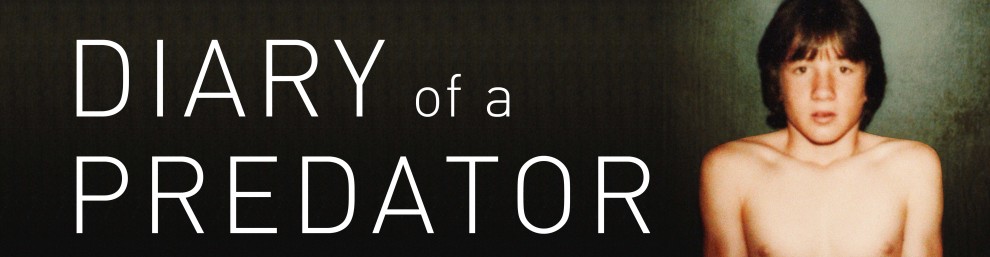
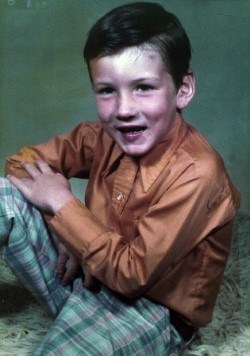
This is Brent’s first grade picture. His father had been raping him for three years by then. A few weeks after this next picture was taken,
BRENT J. BRENTS — At age 13
when Brent was 12, his father beat him so badly that Brent suffered what medical records described as a left orbital blowout fracture—his left eye socket was broken. He’s had seizures ever since. I will spare you the details of the sexual torture he endured. He said his father told him that he himself had been beaten and sexually abused as a child by his father, Brent’s grandfather.
And so the pattern repeated. Pain, degradation, shame. Brent Brents did to others what had been done to him as a boy, and while he was still a boy, like many victims, he blamed himself. He once wrote, “I can’t remember much about when I was real young except fear and shame and lack of courage.”
Shame is an enormous trigger of violence. Brents told me that after that detective said to him, Turn yourself in you little punk, he, Brents, worked himself into a rage. Then he went on his final horrifying crime spree.
I’m not saying these factors are an excuse for the violence Brents inflicted upon others. He made choices. He absolutely deserves to spend the rest of his life in prison. But knowing what happened to him helps explain why someone like Brents committed such violence with a lack of empathy–that his brain was predisposed toward it, and the abuse inflicted on him was his model.
It’s human nature to want to distance yourself from someone like him. Label him as a “monster,” dismiss him as evil, because we don’t want to have anything in common with such a monster–it could mean we, too, are capable of monstrous things.
It also makes it too easy. When we put rapists in the category of “monster” it may make us feel safer today but it’s more dangerous for tomorrow. Because then we won’t believe that the “monster” can be a neighbor, a good friend, a coworker. That enables them to hide in plain sight.
The dominant theme of how to prevent sexual assault today is cloaked in helpful advice, like don’t walk alone, don’t drink, don’t put yourself at risk—and the message, primarily to women, is, Don’t. Get. Raped.
How about we turn the spotlight to a different population and say, Don’t. Rape. And then take it one step further and ask, what are we doing wrong as a culture that we continue to produce rapists? Because whether it’s the ex-convict who attacks a stranger, the college boy who rapes his girlfriend or the celebrity who drugs and assaults his victims—they’re all choosing to exert their anger, power and control over someone else. With that choice, they are all the same, and they all leave pain in their wake.
I’ve interviewed more than fifty survivors of campus sexual assault in the past two years alone and the details I learn about their perpetrators paint a picture of SO MANY young men being deliberately predatory. They isolate their intended victim, ply them with alcohol or drugs, lock doors, ignore tears, ignore pleas to stop or ignore the fact their victim is limp with fear or is unconscious.
Ten years ago, Brent Brents was sentenced to 1,509 years. Today all over this country we are seeing new generations of serial rapists. Why is this still happening?
Why do we continue to reinforce the message to boys and young men that their worth is linked to their ability to dominate?
What if we prized compassion more than power?
When they’re little, we tell our children to play nicely in the sandbox.
As they get older, we say, don’t get in fights on the playground. Take a breath, count to ten, walk away.
Then they get even older and we teach them about the biological aspects of sex—health and reproduction.
What if we evolved those conversations with our youth, and teach them how feeling shame, feeling powerless or feeling angry–all of which cover up hurt and rejection—COULD cause them to want to dominate someone else?
And that they can learn to recognize triggers and not act upon them.
At least start that conversation.
And then speak up if you witness predatory behavior—and you’ll know it when you see it. Don’t make excuses. Don’t look away. Don’t cover it up.
And because sexual violence happens on a continuum—escalating from verbal harassment to physical attacks–Speak up when you hear or read a joke about sexual assault, or victimization. It’s not funny, it’s not sexy. It’s dangerous.
If someone confides in you they’ve been assaulted, believe them–false reporting is extremely rare, so yes, believe them. Listen to them without judgment. Help them find resources, and then support whatever they decide to do.
For perpetrators– Brents told me that group counseling for sexual offenders in prison does not work. For an inmate to even be seen going to sex offender group risks their safety, and once there, they don’t want to be seen as vulnerable. It’s hard to change when you’re living in fear. And if we really do want to help them try to change, let’s offer more of the respect and compassion that can be felt with one-on-one, focused attention—something a damaged person desperately needs.
Instead of building more prisons and focusing only on punishing the perpetrators, why don’t we try to prevent them?
Filed under The story
Have You Ever Met a Monster? Part II
Note from Amy: Here is the next excerpt of the transcript of my TEDx talk:
Police caught him a few days after Valentine’s Day. At the start of that weekend a detective had gotten him on the phone and said Turn yourself in, you little punk. Brent Brents essentially replied, Come find me. That weekend he raped five victims, including two children, and nearly beat a young woman to death. The DNA from those cases was processed within hours and the manhunt that followed ended in a dramatic car chase into the mountains, where police captured him at gunpoint.
This kind of story causes a media feeding frenzy. Reporters swarmed the jail, but I didn’t —I didn’t think it would do any good.
Instead, I sent him a letter on plain stationary—handwritten, two sentences: Dear Brent, I went to Arkansas where I talked to your mom and sister. If you were to ask them, they would say I treated them with dignity and respect, and I will do the same for you.
I then gave him the number to the newsroom and told him to call collect anytime. And because I figured he’d be getting a lot of hate mail, I added a note to the back that said: Please don’t be afraid to open this.
At the end of that week police released a statement about another confirmed victim of Brents. Since they protect the identity of a victim of sexual assault they will only release the cross streets close to where it happened.
Get thee to those cross streets, you and a photographer, editors said. Find this anonymous victim, and get her to talk to you.
Right.
So off we went to those cross streets and we found…a sea of rental units, like giant Legos, for rows and rows in either direction.
We knocked on doors for hours—no luck. It was close to dark when we saw a woman walking her dog—dog walkers are always great for information—and she said the handyman had told her about a woman who’d been attacked and she gave us the handyman’s door number and he gave us the victim’s door number and I knocked and a man answered and I saw this tiny, dark-haired woman hiding behind the door and I identified myself and she came out and said, “You scared me.”
Her name was Margaret. And she told me her story. Her attack was nearly three weeks earlier and she still had yellow outlines of bruises on her neck. She was coming home after running errands when Brents had rushed her at her front door. She had seen him before-she figured he had stalked her for about three days. She fought him, and he beat and choked her before he raped her.
Margaret pointed to her couch, which had a big chunk cut out of the upholstery. The police had taken it for evidence because that was where the rape had happened. When you can’t afford a new couch, and you can’t afford to break your rental lease and move—and Margaret couldn’t—then you have to live with reminders of your worst nightmare.
She said the police had told her it would take about two months to process the DNA. They gave her no hope of solving her case. Then she saw a story about Brents being wanted on T.V. and recognized his mug shot as her attacker.
One of the last things she said to me that night really struck me. She said, “I hate him, yet I still feel sorry for him. An animal, poor creature.”
A week later Brents called me.
One of the first things he said to me was, “I’m not going to give you anything.”
I love it when people call me and say I’m not going to talk to you. “OK!”
Then he said he had one question for me, and anything further depended on my answer.
And he said, “Everybody says they hate me, that I’m a monster. Do you think so?”
And without thinking I said, No, I don’t. You’ve done monstrous things, but I don’t consider you a monster.
And that’s how we started a correspondence. I did so on one condition: that he tell me the truth. In one letter he wrote, “Don’t trip I’ve actually stood two feet away from you in an elevator” and rolling my eyes I pulled out a piece of paper to fire back that we had a deal, so don’t try to b.s. me—when I realized it had indeed been him on the elevator that day, the man who had stared at me and whose very presence had caused me to run to the newsroom like a frightened rabbit.
Filed under The story, Uncategorized
What I Said During the TEDx Talk: Have You Ever Met a Monster? Part I
Note from Amy: A woman contacted me the other day and said she would love to have the transcript of what I said during my TEDx talk.
So as not to overwhelm readers, I will post it in excerpts, starting with this first one:
Have you ever met a monster? someone so scary they alerted the reptilian part of your brain?
One morning as I was going to my job as a criminal justice reporter in Denver, I stepped into a crowded elevator, faced front and got the sense someone behind me in that was watching me. I glanced over my shoulder to see this man staring at me in a very calculating way, with cold shark eyes. So I stared back—and my look said, Rude person! and he didn’t drop his eyes, so I ended that contest and turned back around, alarm bells sounding in my head. I instantly decided I didn’t want him to know which floor was mine, so at the next stop just before the doors came together I darted out at the last minute, and then I flew up the stairs and ran into the newsroom, my heart pounding.
The fear of monsters is instinctive.
In Denver in 2005 reports of a serial rapist had residents so frightened some were carrying baseball bats.
Police released his name, Brent Brents, and the media scrambled to find out whatever we could on this guy. A reporter at the rival newspaper got Brents’ sister in Arkansas on the phone, and she said, “He deserves whatever he gets” before hanging up. One sentence, but, we’d been scooped!
Get thee on a plane to Arkansas, my editors said. Find his family, and get them to talk. So I did. Brent’ mother described him as willful, intelligent. He had grown up hunting and fishing, ran track, wrestled, boxed. He had a learning disorder, and became frustrated, then angry, in school. He started smoking pot and drinking at age 10, and that’s when he began beating his mother. When he was 13 he pulled a switch on a railroad track and was sent to juvenile detention, where he was in and out until the age of 18 when he was convicted of raping two children. He served sixteen years in prison before being released without supervision.
His sister mentioned that Brent had a lot of anger toward their father, who had died the year before.
So I turned to the mom and said, I’m sorry to ask, but this is a standard question when someone sexually abuses others. Was Brent ever abused as a child?
There was a long pause. And then looking down she said, Brent makes up all kinds of lies.
Filed under The story
Have You Ever Met a Monster?
Giving a TEDx talk was not on my bucket list.
But a friend sent me a link to submit a talk proposal and before I knew it, I faced the daunting task of trying to condense this story–of how covering the case of serial rapist Brent Brents changed my life–into 18 minutes.
Two days before the scheduled date of the talk, I threw out my back (I wish I could say I was bungee jumping, or ice climbing, but the truth is I was emptying a wheelbarrow full of horse manure into a compost bin), resulting in a) no sleep and b) shooting pain with every step.
So the finished product is not pretty. It’s not full of video or power point dazzle. But those 18 minutes contain some tough truths about rape, sexual assault, incest, child sexual abuse, and, most startling of all, forgiveness. I wanted to share it with you, so click on my TEDx talk here: “Have You Ever Met a Monster?”
And then let me know what you think.
–Amy
Filed under The story
Rape was a murdering of the soul
So I’ve heard this lately (It was consentual.) Holy crap it enfuriates me. How do 5 year olds consent with a man shoving a penis in their asses repeatedly. Or an unconcious woman consent. These guys use this to make it ok, or make themselves less responsible. I know I’m No better than these guys who tell me this. I tried the same crap for a minute. Yet i came to the reality that they (the victims) did not consent. By saying it was consentual, I placed the responsibility on the victims. I just can’t see why i needed to do this. It didn’t make me feel any better. I still knew i was predatory. I still knew Rape was a murdering of the soul.
Don’t get me wrong that same person Resides within me. But i know i have to constantly be aware of how i am thinking. When i get angry or anxious i become that person again. I don’t rage as often as i used to. I credit my pysch meds for that. But still i rage inside sometimes.
-Brent Brents 2-20-15
Filed under Brents' writings
i never realy meant for you to hurt so. But it helped me.
Note from Amy: For the first time, Brent Brents was recently able to read the book I wrote about covering his case, Diary of a Predator: A Memoir, which includes the correspondence between us leading up to his trial and immediately after, in which he told me about his crimes and his motivations for committing them. That correspondence, which was often painful for me to read, is what he’s referring to here:
Watching you suffer thru my hate and anguish realy tears at my heart. I think that had i realy understood just how deeply you were hurt by alot of that stuff, i would have held back and that would have led to B.S.
So i am glad you held alot of your feelings back. Because i realy never meant for you to hurt so. But it helped me.
I cried thru much of the book. Tears of anguish at the wasted and destroyed lives. And tears of joy at all the accomplishments…
I’ve finaly started a good life. It’s full of love, compasion and even empathy. I still don’t like many people. Mostly because most people I come in contact with are full of shit. Or have some screwed up motive for trying to befriend myself and others.
So yeah the book is a stark reminder of just how vulnerable i was and still am in ways. Plus a scary reminder of the hate and rage i am capable of having and storing up, and venting blindly.
-Brent Brents 1-20-16
Filed under Brents' writings


 Diary of a Predator