Category Archives: The story

Reader: I have come to the place, that while painful, my rape still provides me with possibility.

Hello again, I hope that today is a good day for you, with new possibilities for the coming year. Your book, that I read several months ago still resonates powerfully with me and was instrumental in finding peace and empowerment. On reflection of your words, it occurred to me to say that from my experience, the full impact of the rape/abuses I experienced are not the sole responsibility of the abusers/rapist(s).

The acts themselves were painful, yes. The ones that happened repeatedly, I got used to and developed a way of removing mind from the place I was in. But the physical injuries healed within a week. The real impact by far, what really stuck, was the shame I felt for many years. I was to blame. I should never have found myself in that position. Why couldn’t I have prevented it? While I didn’t provide consent for being raped (being blind drunk), neither did I fight for all I was worth while I was violently violated by two men I’d just met. I spent years ruminating on the moments like when the taller one said “Where do you think you’re going?” before I found myself on the bed. Why hadn’t I shouted or kicked him in the balls then?…

I took on the blame and shame from other people’s reactions (notably women, I observed) and while they were never identified or convicted, I imposed my own life sentence on myself. Letting yourself off the hook, or denying your part is one thing Brent, and I acknowledge your courage in taking on the responsibility for your role and suggest that you may be taking on more than is yours.

I read with interest, your view that “rape is worse than murder.” I have come to the place, that while painful, my rape still provides me with possibility. The story I tell about my experience is mine to tell, and I no longer feel that it ruined my life. It’s brought a new level of relatedness to others, to women, to men, to children, to you. If I were to meet those men again, I have realised just this second, as I’m writing these words, that I would thank them. If they’d murdered me, I wouldn’t be able to do that would I? If I’d succeeded in murdering myself , as I had considered and prepared for, I wouldn’t be in this place now. Today, I’m grateful, awake to being alive and I believe in that possibility for everyone, without exception.

I ‘ve recently watched a film called “The Work” which documents an extraordinary programme which takes place at Folsom State Prison. Run by the Inside Circle Foundation. The men who participated having experienced traumatic, chaotic, abusive pasts come to tell of their experiences and with great courage and vulnerability proceed to breakthrough.

I was deeply moved and my mind came to you, as I was watching. I asked myself, what would it be like if this was available for you. You may already be aware of this programme and foundation. If not, you may want to take a look…

With love and respect to you (both), Emily

January 11, 2018

Leave a comment

Filed under reader comments

Reader: my emotionally and physically abusive father is not a monster – he is a sick person

I can’t believe the timing of finding your Ted Talk video. I haven’t even actually finished it, but I’m so amazed that you have articulated what I only just began to realize through my CBT sessions myself: my emotionally and physically abusive father is not a monster – he is a sick person who needs help. Although he is very intelligent, he lacks empathy and inflicted pain and suffering on those closest to him.

I’m only just starting to unravel the pain of my childhood and was recently ‘diagnosed’ with PTSD. I don’t know anyone else who’s ever gone through this, so I am in awe that you mirrored my recent breakthrough, that was years in making, into a 17 minute speech.

I’m crying right now because I am so relieved.
Thank you very much,
Ashley from Montreal, Canada

January 10, 2018

——————

Dear Ashley,
 
Thank you for taking the time to send such a thoughtful email. It’s very gratifying to get a message like this one; it reinforces that this work is worthwhile. 
 
I’m sorry to hear about the abuse your father inflicted upon you, and I applaud you for working on your healing. And I’m very glad that my TED talk was able to help you in any way. 
 
I would like to post your letter on the Diary of a Predator blog–not identifying you of course–if that would be OK with you? Please let me know. If it is, let me know how you’d like to be identified-such as first name only, or no name at all.
 
Again, thank you for writing. It’s letters such as yours that keep me motivated to do this kind of work. 
 
All my best,
 
Amy Herdy
January 10, 3018
———————–
Hi Amy,
You are welcome to post my email, and pls identify me only as Ashley… You can include Montreal.
I read more of the letters you posted and I’m surprised by how many people suffer from PTSD as a result of abuse. I guess I’m naive, because I thought it was only something soldiers had.

I wish you success in your work, and if you ever come to Montreal for a talk, I will be sure to attend 🙂

Best,
Ashley
January 11, 2018

Leave a comment

Filed under reader comments

Reader: I honestly believe that he wanted to be different than the person he became

I read your book and have followed the blog on and off over the years but not every post. In the book I noticed that one of the themes was that Brent “fell through the cracks” and that he never got the support for his own abuse.

My question is if he ever spoke about being locked up as a teen in a Youth program for violent and sexual offenders. C.A.T House. (Closed Adolescent Treatment Center)?

I do know that he was there for rape and that he was given every opportunity possible for some sort of rehabilitation and a chance to steer himself to a different life. The program at the time was the most successful program for youth offenders in the country.

I struggle with the idea that he had been totally cast aside because the truth is somewhat different from my perspective. Each individual is affected differently and someone wanting to change is critical but I do know he had the opportunity.  I may have missed it in the book but was curious if this was something he spoke to you about?

I have thought about sending this on and off over the years because I am torn in the idea that it is important for people to understand but also in the idea that he does not deserve a platform to manipulate and seek further attention. I do know that we have to help change the culture and environment that creates predators/victimizer’s and most importantly victims.

I appreciate your diligence in bringing a story forward that nobody really wanted to know or hear but is important to be told. Not for Brent but for all of the victims and for all of those who were abused and never found a voice.

Thank you,
Jason

January 5, 2018

——————————

Hello, Jason,

I will try to address your questions and concerns in order.

The first is that one of the themes of the book is that Brent “fell through the cracks.” While I do believe the facts of his case support that statement–that he was removed from an abusive home, and then returned–I don’t know that I would call it a theme. The themes of the book, in my opinion, are abandonment, generational patterns of abuse, the effects of both victimization and predatory behavior, and transformation that involves compassion and empathy.

Please do not misunderstand that I feel sorry for him. If you’re looking for clarity on how I feel about him and his case, you may want to read “The Story” on the website, in which I say in part:

“Where does the blame belong? It belongs to Brents, certainly, for his choices. And what of his parents, and their parents before them, who perpetuated the cycle of incest, domestic violence and child abuse?”

The book does not say, nor have I, that he never got support for his own abuse. He has said that he was given the chance for therapy and treatment–I do not recall him specifically mentioning the C.A.T. House, although I could ask him–and that by the time it was offered, he was not interested.

I do not believe that he was totally cast aside. I do believe him when he says that by the age of 9, his brain was broken, and that he chose to be a predator because it gave him a feeling of power, and that was more appealing than feeling like a victim.

I stay in touch with Brents, and post blogs from him, not to give him a platform to seek attention or be manipulative, but to show some of the causes of why he became predatory; that he is, indeed, human; and to illustrate his case, because so many elements of it are indicative of what’s wrong with our social justice system. I understand you object to the blog, and I appreciate you taking the time to tell me; however, please know that I will continue it.

I also appreciate the fact that you have obviously had some experience with this topic and cared enough to write. I now have a question for you: Would you object to my posting your letter on the website? I would not include your email address, of course. Let me know.

Last, I absolutely agree with you that we have to change the culture that creates predators and therefore, survivors.

Here’s to hoping for a brighter future.

Regards,

Amy

January 5, 2018

————————-

 Hi, Jason,

I had a chance to talk to Brents today, and he does remember being in the C.A.T. House. And he remembers a Jason who was serving time there, too, and spoke well of him.

If that’s you, then he sends a greeting.

Also, please let me know if it’s OK with you if I post your letter.

Regards,

Amy

January 12, 2018

—————————–

Hello Amy,

I do not want to create any issues for any of his victims or for you or lastly Brent,  so I will leave it to your judgement as to what is appropriate to post.

I was in the C.A.T House with Brent.  I know that the program, truly gave him/myself and others the chance to be better people and to change. While I do not think we can ever make amends for the wrongs we have done, we can live a life that serves others as well as ourselves. Has accountability and promotes healing of our own damage and demons.  That was a fundamental part of the program.

I do understand that some people were not in the place to change, did not want to change or perhaps were too broken to change. I can not say for anyone but myself.  I just wondered why it was something he never mentioned as it was a large portion of time for him (2 plus years I believe of intensive daily 24-7 treatment)

I can say that I have seen both sides of Brent from the perspective of a child, it breaks my heart that he continued to create more victims and I am beyond angry at who he chose to become. I am grateful that he is in a place where he has less opportunity to cause harm to others.

That being said,

I  also mourn for that young man who never lived a different life, he had hopes and dreams and at least then… I honestly believe that he wanted to be different than the person he became. I understand a minuscule amount of that abuse he suffered and I appreciate him being open about it.  My hope is that it will help to stop those who abuse children and those who will become abusers.  I hope that Brent finds some peace and can make what remains of his life valuable to himself and those that he involves himself with.  He still has a choice how he faces each day. I do think he can still use his life for the better, perhaps if he is being true this forum is just that.

I am going to read your book again tonight for some additional clarity.  I watched your T.E.D talk and I applaud you for continuing to wade into a subject that most people who have not experienced have little interest in talking about as it is not shiny and pretty. More so for those who have experienced it and were/are to broken and  ashamed to think they might deserve/need help before it is too late for themselves or someone else.

Thank you for the clarification and answers to my questions. In reading over them I think I could of been far more articulate and specific and have used less of a broad brush. I was mostly referencing my experience with Brent in his teens but I was about as clear as mud.  I  apologize for not being clear, it was uncomfortable to write and I should of taken more time. I do not think you felt sorry for him. I appreciate the balance you were able to find. Much like the Staff at the C.A.T house, my  perspective is that while condemning the acts and behavior, you were able to set that aside to see the larger picture and why it is important to share and attempt to educate. But also to see a young boy who before becoming a predator was preyed upon.

Thank you,

Jason

January 13, 2018

Leave a comment

Filed under reader comments

grab the faces of people who choose to look away from the abuse and exploitation of children

Dear Amy, thank you for your profound and powerful contribution. I watched your you tube video and read the blog and was profoundly moved by the courage of both yourself and Brent. Having experienced rape, it has brought me to a place of forgiveness both for the rapists, those who I’ve blamed as enablers of rape and finally myself. I have no idea where this comes from, and it may sound perverse to some, but I believe the world is a better place because Brent is in it, to shake up the status quo, to speak out about abuse, to grab the faces of people who choose to look away from the abuse and exploitation of children.

However hard a lesson he has brought to the world, a powerful lesson it is. And it is because of this that I right in concern for his welfare. Having read the last couple of entries that he’s sent to you, the tone feels different and I may be way off the mark but it may be idea to check if he has intentions of suicide. He may not have the means, so is probably safe but to ask the question all the same.. From someone who has had experiences of feeling hopelessness, and sensing it in others drives me to take action to prevent someone ending their life. There’s always possibility for a person in life (of goodness, inspiration, love etc), that possibility ends abruptly in death and the pain doesn’t end. It is merely transferred to others. Apologies if this is a waste of your time; however, I don’t apologise if I’m wrong and have misunderstood his writing – I’d rather check that live with regret. With best wishes to you and to Brent.

–Emily, Southwest England.

September 12, 2017

Hello, Emily,

I did not think you would mind–I sent the content of your message (with your first name only) to Brent Brents, and he replied.

If you want to read his response–he was grateful-it’s copy and pasted below.

I would like to post your letter and his response on the website if that’s OK with you, using your first name only and that you are from Southwest, England.

Let me know if that’s OK.

Take care,

–Amy

September 13, 2017

—————————

Hello, Amy, Absolutely, I trust your judgement…

–Emily

January 11, 2017


Dear Emily,

Yes in answer to your Q. I have often thought of suicide lately. Not that i would do it. Amy and others have put a life times worth of work into showing me that love and compasion are real and worth living for. And living to give. And yes suicide creates more pain than it eases. I could never bring myself to hurt those who do love and care for me in such a selfish way.

I do not get to read but little of the blog, so i am not sure how much Amy has put on there about my Manic Depression. The drugs work pretty well. It is when i am stressed that they lose some and i either freak out or get depressed. Sometimes it is quite a roller coaster of emotion. I know in my manic state Amy and my friends would often like to strangle me. 🙂 I can be a real ass, and not know it.

Right now i am dealing with where they are going to place me after get out of this six month confinement. If they put me in general population i will be hurt or even killed. So i am trying to go to protective custody. But there is a process, and no garuntee that that is where i will be placed. So i am continually stressed these days.

Fearing for my safety isn’t new to me. But the thought of not being around to love and care for, and have A, and F. as the most vital part of my exsistance chills me deeply. Its a fear i am not used to.

So Emily, no your Q is not off the mark or a waste of time. Thank you for concern. Sincerely, Brent.

September 27, 2017

Leave a comment

Filed under reader comments

I carry no shame for what someone else did to me

From a reader: I want to disclose am a survivor. I do not hide this fact. I carry no shame for what someone else did to me. However I do not typically feel the need to share the fact either. The truth is most people do not know this about me. I know that what you do as to Brent Brents revolts many people. Their response is a result of fear. When you look into the abyss … I am not sure how much if any positive feedback you receive. I wanted to tell you from the perspective of a survivor that I believe you are on to something. How can we begin to heal this epidemic if we cannot grasp any understanding of it? Keep up the good fight.
-Beau, Wednesday, Nov. 29, 2017 8:52 p.m.

Leave a comment

Filed under reader comments

Survivor: “I have been trying to find the courage to speak about having compassion for perpetrators of violence”

Comment: Hi Amy Herdy,
Your Ted talk led me to this website. As a survivor of childhood sexual abuse, I want to thank you so much everything that you have brought to light in the talk and in writing, as I feel that it is something that needs to be said. I have been trying to find the courage to speak about having compassion for perpetrators of violence like this, because while it is hard to learn to forgive, there is a fact that I truly believe in: every person who does harm has been harmed.

I strongly believe this because of the stories I was told throughout my childhood by people who abused me. Almost every single one of them had a story about being abused as children, and they would often tell it to justify why they were hurting us. As a child, I was “trained” in very specific ways in how to abuse other children and in how to recruit children to bring back to sick adults to be abused. I have watched cousins and childhood friends turn to addiction and take on masks of mental illness to try to disguise what happened to us as children.

The reason that I feel compassion in spite of the anger about my life, is that, had it not been for a couple of extremely loving adults in my childhood who balanced out the pain, I cannot say that I would have turned out any differently than those who abused me. I experienced abuse as a sickness that is passed from generation to generation or from person to person. The difference with sexual abuse is that, unlike having a leg cut off and bleeding all over the place for the world to see, it is something that is so stigmatized and set in the category of “sexual.”

Knowledge of healthy sexual relationships isn’t something that children are typically exposed to as it is. But this is not a “sexual” thing. It is a “power” thing. In my experience, sexual abuse has more to do with one person feeling so powerless in themselves that the only way that they feel like they can have any sense of power in life is through taking advantage of others who are more vulnerable to them. This is the sickness.

In our society, we treat the symptoms of this sickness by throwing perpetrators and victims in jail, instead of trying the much simpler path of prevention. It makes way more sense to help children than to try to patch together broken adults. Thanks again for your work.

-Hannah

Time: June 29, 2017 at 6:42 pm

1 Comment

Filed under reader comments

Forensic Pediatric Nurse in Oslo: “We are seeing SO MANY cases of rape and incest involving child-on-child acts”

I have worked as a forensic pediatric nurse practitioner for 15 years and am seeing some alarming trends. Some of them you talk about in your tedtalk, but others I am wondering if you and the rest of society have really come to realize?

We are seeing SO MANY cases of rape and incest involving child-on-child acts that we never saw before, and it seems like parents and teachers are completely clueless as to how to deal with or prevent it. As well, we are seeing teens not even recognizing they have been raped (until the video of it shows up online and the police contact them) because they have watched so much of it online, music videos, etc that it is normalized.

I just want to scream and tell this society to WAKE UP. It is shocking and tragic and I would SO like to get the word out. I work in Norway now and the problem is no different. If you would ever like to hear more about it please do not hesitate to contact me. I would be thankful to share specific circumstances and concerns.

Sincerely,
Mary Jo Vollmer-Sandholm

Forensic Pediatrics Consultant at Oslo University Hospital

Leave a comment

Filed under reader comments

It is easy to hate violent people. It is harder to see what creates them.

Note from Amy: This was a reader comment sent to this Diary of a Predator website:

It is rather seldom that I have tears in my eyes when reading accounts of trauma. But I did this time. It is easy to hate violent people. It is harder to see what creates them. In Brent’s case, he was abused so horribly in childhood that it is astonishing that he survived. I bow down to Margaret in respect and admiration. How she can forgive, I don’t know. I doubt if I could forgive. It is true that hatred does more harm to the hater than the hatee. Thanks for writing this.”

-Susan

Time: January 21, 2017 at 12:41 pm

Leave a comment

Filed under reader comments

Have You Ever Met a Monster, Part IV: Our society cares more if a sexual assault victim is the right kind of victim

Brent BrentsBrents has often said that by the time he was 9, his brain was broken.

What if someone had intervened in his life early on? A teacher? A neighbor? How could no one have noticed that boy who went to school with bruises, smelling like urine because he had wet the bed the night before rather than creep down the hall to the bathroom and risk waking his father?

If you help an abused child, you might be preventing a lifetime of pain—for more than one person.

So many people live in what I call “garage houses”—where the garage is the dominant feature. They pull up to their garage at night, the door goes up, their car goes in, and the door comes down. They stay inside their house until they leave the next day. They can’t tell you the name of the family down the street. They won’t interact and they sure won’t intervene.

What if we dared to care—without hesitation, without condition?

It’s a harsh truth that our society cares more if a sexual assault victim is the right kind of victim. Remember how police told Margaret the DNA from her case would sit on a shelf for at least two months? When Brents attacked victims in a high-income neighborhood, the DNA was processed within hours.

Lady Justice might be blind, but she can sure have a champagne taste.

Margaret and I talked often while her case wound its way through the court system. During a hearing in July 2005, Brents pleaded guilty to Margaret’s attack.

Like many survivors who struggle with Post Traumatic Stress Disorder, Margaret was terrified of leaving her house. She had flashbacks, nightmares. She couldn’t hold down a job. Her marriage fell apart.

On the day before the hearing, Margaret asked me to deliver a message to Brents for her, and I agreed. And this was her message:

“Tell him…I forgive him.”

It’s stunning, isn’t it? How could she forgive this man who wounded her so, who nearly took everything from her?

She said, “I’m not feeling bad for the man who tried to kill me, but for the little boy who had the same thing happen to him.”

And she said, “Hating is not hard. But if I go on hating him, I will never get over it.”

Then she added, “If it was me, I would want people to try to help me or try to listen to me and not just look at me like I’m an animal or a monster.

She inspires me. If Margaret can forgive Brent Brents, we can forgive anybody.

This case had a profound effect on my life.

It taught me that we’re all connected, and turning our backs on others is really abandoning ourselves.

It made me realize that I didn’t like the journalist I had become. It was actually Brents who pointed out to me that he and I had something in common: We were both driven.

I quit that job shortly after his case ended. I will never again work in a newsroom because the desperate competition for ratings is unhealthy for me, in many ways.

And I no longer knock on a survivor’s door unless I’m invited.

I began interviewing Brents because as a journalist who has spent a lifetime reporting on sexual violence, I wanted an answer to the question, “Why?”

He began as a bug under a microscope–and that’s what I told him.

He became a lesson in humanity and compassion.

Even so-called “monsters” have things they’re afraid of.

Brents wrote me about his. He said,

“My biggest fear is that I will die (pause) without ever having done anything  good.”

That’s why I tell this story. Thank you for listening.

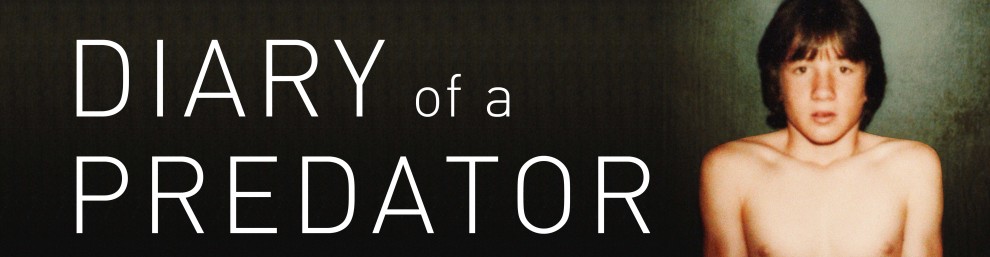
BRENT J. BRENTS -- At age 13

BRENT J. BRENTS — At age 13

Leave a comment

Filed under The story

Have You Ever Met a Monster, Part III: What are we doing wrong as a culture that we continue to produce rapists?

It turned out that Brents had followed my work. A few months before he was released from prison I had finished co-authoring an investigation into how the military mishandles domestic violence and sexual assault. It resonated with him, not because he was a perpetrator, but because the angry man-child within him, considered himself a victim.

Records and accounts from family members indicate that Brents’ father was a violent, sadistic man. The two children from his second marriage were removed from the home because of his abuse, and Brents and his brother, the product of his father’s third marriage, were also removed from the home, although for unknown reasons, Brent was returned.

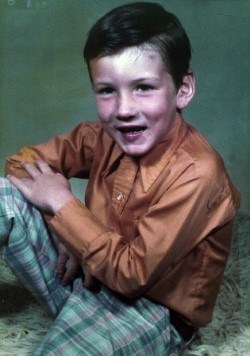
Brent BrentsThis is Brent’s first grade picture. His father had been raping him for three years by then.  A few weeks after this next picture was taken,

Brent Brents

BRENT J. BRENTS — At age 13

when Brent was 12, his father beat him so badly that Brent suffered what medical records described as a left orbital blowout fracture—his left eye socket was broken.  He’s had seizures ever since. I will spare you the details of the sexual torture he endured. He said his father told him that he himself had been beaten and sexually abused as a child by his father, Brent’s grandfather.

And so the pattern repeated. Pain, degradation, shame. Brent Brents did to others what had been done to him as a boy, and while he was still a boy, like many victims, he blamed himself. He once wrote, “I can’t remember much about when I was real young except fear and shame and lack of courage.”

Shame is an enormous trigger of violence. Brents told me that after that detective said to him, Turn yourself in you little punk, he, Brents, worked himself into a rage. Then he went on his final horrifying crime spree.

I’m not saying these factors are an excuse for the violence Brents inflicted upon others. He made choices.  He absolutely deserves to spend the rest of his life in prison. But knowing what happened to him helps explain why someone like Brents committed such violence with a lack of empathy–that his brain was predisposed toward it, and the abuse inflicted on him was his model.

It’s human nature to want to distance yourself from someone like him. Label him as a “monster,” dismiss him as evil, because we don’t want to have anything in common with such a monster–it could mean we, too, are capable of monstrous things.

It also makes it too easy. When we put rapists in the category of “monster” it may make us feel safer today but it’s more dangerous for tomorrow. Because then we won’t believe that the “monster” can be a neighbor, a good friend, a coworker. That enables them to hide in plain sight.

The dominant theme of how to prevent sexual assault today is cloaked in helpful advice, like don’t walk alone, don’t drink, don’t put yourself at risk—and the message, primarily to women, is, Don’t. Get. Raped.

How about we turn the spotlight to a different population and say, Don’t. Rape. And then take it one step further and ask, what are we doing wrong as a culture that we continue to produce rapists? Because whether it’s the ex-convict who attacks a stranger, the college boy who rapes his girlfriend or the celebrity who drugs and assaults his victims—they’re all choosing to exert their anger, power and control over someone else. With that choice, they are all the same, and they all leave pain in their wake.

I’ve interviewed more than fifty survivors of campus sexual assault in the past two years alone and the details I learn about their perpetrators paint a picture of SO MANY young men being deliberately predatory. They isolate their intended victim, ply them with alcohol or drugs, lock doors, ignore tears, ignore pleas to stop or ignore the fact their victim is limp with fear or is unconscious.

Ten years ago, Brent Brents was sentenced to 1,509 years. Today all over this country we are seeing new generations of serial rapists. Why is this still happening?

Why do we continue to reinforce the message to boys and young men that their worth is linked to their ability to dominate?

What if we prized compassion more than power?

When they’re little, we tell our children to play nicely in the sandbox.

As they get older, we say, don’t get in fights on the playground. Take a breath, count to ten, walk away.

Then they get even older and we teach them about the biological aspects of sex—health and reproduction.

What if we evolved those conversations with our youth, and teach them how feeling shame, feeling powerless or feeling angry–all of which cover up hurt and rejection—COULD cause them to want to dominate someone else?

And that they can learn to recognize triggers and not act upon them.

At least start that conversation.

And then speak up if you witness predatory behavior—and you’ll know it when you see it. Don’t make excuses.  Don’t look away. Don’t cover it up.

And because sexual violence happens on a continuum—escalating from verbal harassment to physical attacks–Speak up when you hear or read a joke about sexual assault, or victimization. It’s not funny, it’s not sexy. It’s dangerous.

If someone confides in you they’ve been assaulted, believe them–false reporting is extremely rare, so yes, believe them. Listen to them without judgment. Help them find resources, and then support whatever they decide to do.

For perpetrators– Brents told me that group counseling for sexual offenders in prison does not work. For an inmate to even be seen going to sex offender group risks their safety, and once there, they don’t want to be seen as vulnerable. It’s hard to change when you’re living in fear. And if we really do want to help them try to change, let’s offer more of the respect and compassion that can be felt with one-on-one, focused attention—something a damaged person desperately needs.

Instead of building more prisons and focusing only on punishing the perpetrators, why don’t we try to prevent them?
2 Comments

Filed under The story